Before Building Your GLP-1 Product Strategy, Answer These Four Questions
Blog
5/18/26
Before Building Your GLP-1 Product Strategy, Answer These Four Questions
By Mary Elzey, Emily Creek and Dani McDonnell · Stable Kernel · Customer Insights and Strategy
TLDR; Before committing budget to any GLP-1 product or platform, health and wellness brands must answer four research questions: (1) Which use case and phase are your consumers actually in? (2) Where in their journey are they making decisions you're not seeing? (3) What sources do they trust before they reach you? (4) What would they pay for that you don't currently offer? Skipping these questions is how brands build the wrong thing at scale.
Somewhere inside your company right now, there's a slide deck circulating about GLP-1.
Maybe it proposes an AI coaching feature. Maybe a meal plan reformulation. Maybe a telehealth partnership. The pressure to ship a response is real, the timelines are short, and the budget is available. Most product leaders we talk to are ready to move — but they haven't yet articulated a definition of the GLP-1 customer.
At Stable Kernel, we see the consumer shift faster than the research, and that gap shows up in product decisions — sometimes as a missed feature, sometimes as a platform nobody uses, and sometimes as a product that should never have been built at all.
In our experience, clients need to answer four questions before implementing any new health and wellness product, GLP-1 or otherwise.
Who Is the GLP-1 Consumer? Why the Market Data Is Misleading You
The market is real. The consumer you think you're targeting isn't.
The volume story is well-documented. KPMG estimates roughly $48 billion in annual food and beverage losses over the next decade, driven by GLP-1 adoption. Morgan Stanley models about 55 million U.S. GLP-1 consumers by 2035. Circana projects GLP-1 households will account for 35% of all U.S. food and beverage unit sales by 2030. That's the center of the market.
But scale is not the same thing as stability. A large share of GLP-1 users discontinue treatment, and many later restart, meaning the addressable consumer is not a single fixed segment but a population cycling through different needs over time. A 2025 study of more than 125,000 GLP-1 patients, for example, found that roughly half stopped within a year, often because of cost and side effects rather than having reached their goals. Real-world weight outcomes after discontinuation are consistently more modest than those predicted by clinical trials. The population is cycling — on, off, back on — and which phase they're in changes everything about what they need.
Use case is fragmenting too. The same consumer who looks like a GLP-1 user in your data may be using the drug for weight loss, aesthetic transformation, clinical diabetes management, or a broader lifestyle reset. Those uses do not share a common roadmap. Nutritional needs, app behaviors, community engagement, and willingness to spend vary across each one.
Building a product strategy around "the GLP-1 consumer" without knowing which use case dominates your base, and which phase those consumers are in, is how you end up with a feature set aimed at the wrong moment for the wrong segment. That's not a messaging problem. It's a research problem.
GLP-1 Product and Platform Strategy: How Both Approaches Can Go Wrong
Whether you build a product or a platform, the mistake looks the same
Brands in this category have two ways to answer the GLP-1 question. One is through the physical product: reformulate the food, redesign the meal kit, change the portion size, relabel what's already on the shelf. The other is through technology: build a new app, create an online community, acquire existing software and integrations with a wearable. Most brands will do some of both.
Both can work. Both can also become expensive ways to learn that the consumer was somewhere else entirely.
On the product side: frozen foods
On the product side, look at frozen foods. Nestlé launched Vital Pursuit in 2024, its first major new U.S. brand in nearly three decades, designed for GLP-1 users and other weight-management consumers. The line introduced portion-aligned, high-protein, fiber-forward frozen meals with new packaging and branding built around that use case.
Conagra took a quieter path. Rather than launching a new brand, the company added a "GLP-1 friendly" badge to 26 existing Healthy Choice frozen meals that already fit the profile: higher protein, lower calorie, and a good source of fiber. Same food. New label.
Both approaches are defensible. One costs much more to be wrong about. Nestlé is funding a multi-year brand build in a still-forming category, while Conagra is testing GLP-1 demand through a packaging change on products it already has. And the early signals are more ambiguous than the category hype suggests. The Associated Press in 2026 described Vital Pursuit's sales as robust, but noted that 77% of buyers were in households where no one was using GLP-1 drugs. That is less evidence of a precision solution for a new medical-use segment than of a broader health halo with mainstream appeal.
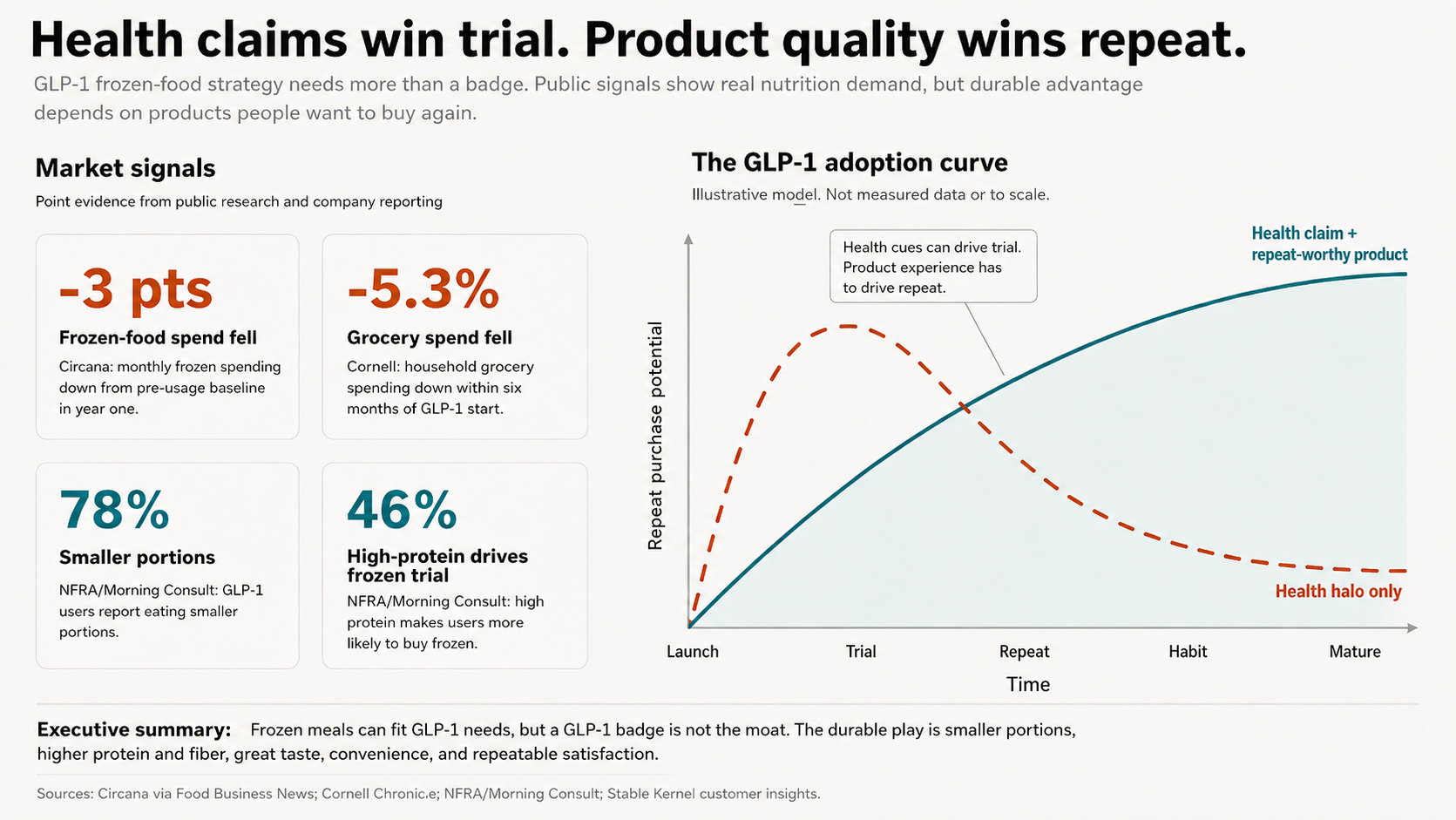
At the same time, GLP-1 users are already reducing their frozen-food spend, and frozen is one of the categories hit hardest as people on these drugs eat fewer and smaller meals. The GLP-1 shoppers who still buy in the category say they want fewer, better options: high-protein, portion-controlled, nutrient-dense meals that justify eating when they actually feel like it. That makes late, "GLP-1-washed" frozen plays look fragile. If the food is not genuinely excellent, a new badge or a new sub-brand may read less like innovation than like the next SnackWell's: a health-coded story that arrives just in time for consumers to move on.
Conagra, notably, had evidence before it changed the package. In coverage of the launch, Food Dive cited Numerator data showing an 8% lift in consumption of better-for-you frozen meals among households with people taking weight-loss drugs, for products that were already in the freezer case. The badge made that demand visible. The cost of being wrong is a packaging revision.
On the platform side: apps and data
The same logic applies on the tech side. Fitness wearables, gym memberships, supplements, and medical aesthetics are all pulling in incremental GLP-1 spend — the platform opportunity is real. But the topline numbers do not tell you which of your consumers is contributing to the lift, or what they're actually using those platforms for.
A fitness wearable strategy aimed at lifestyle optimizers will miss the aesthetic-transformation segment entirely. A clinical-support app aimed at disease management will miss the majority who do not see themselves as patients.
Who comes with you to a new platform, and what has to change for them to stay, are research questions. Most platform investments treat them as already solved.
Find out what your consumers actually need before you commit the budget.
Why GLP-1 Market Research Should Come Before Product Development
We build apps, and we still told a client to shut down their app. Here's what that research looked like.
The research said no. The app was not fixable through reinvestment. It was solving a problem the community did not need solved, and the community was getting value from the organization through other channels entirely.
The decision was to sunset the app. The resources that would have gone into a rebuild were redirected into higher-impact programs and services. The organization saved substantial money and got closer to its community.
Stable Kernel has done versions of this work for nutrition brands hit by GLP-1 directly, for pharmaceutical teams trying to understand patient experience with new therapies, and for health and wellness companies building consumer-facing apps and data platforms. Research-led decisions in this space routinely save more than they cost. The alternative is building the wrong thing at scale.
The 4 Questions Every GLP-1 Product Roadmap Must Answer Before Launch
The four questions most roadmaps skip
If you're heading into a GLP-1 product decision, these are the questions to answer before you start. Most product roadmaps we see undercut the research part because teams believe they already "know the user."
1. Which use case and which phase are your GLP-1 consumers actually in?
Most brands segment GLP-1 versus non-GLP-1, if they segment at all. The more useful split runs on two axes: use case and phase.
Recent consumer research from BCG's Center for Customer Insight segments active GLP-1 users into four distinct purchase archetypes — consumers using GLP-1 as a lifestyle optimization platform (41%), as a focal point for aesthetic transformation (27%), as a tool for clinical disease management (19%), or as the center of an all-in health and wellness reset (13%). Each archetype is using technology, nutrition, and community differently. A fitness wearable aimed at the lifestyle-optimization majority will miss the aesthetic-transformation segment entirely. A clinical app aimed at the disease-management segment will miss the majority who do not see themselves as patients.
Layer that against phase — on the drug, between drugs, recently discontinued, considering reinitiation, in maintenance — and you have a segmentation grid your roadmap can actually use. Behavior, channel, and willingness to pay look different at every point across that grid.
Treating GLP-1 consumers as a single cohort is how brands end up building features that fit neither the consumer nor the phase well.
2. Where in the GLP-1 consumer journey are they making decisions you're not seeing?
The research phase has moved off your channels. GLP-1 consumers are making product decisions on TikTok, Reddit, AI tools, peer communities, and retailer apps — before they get anywhere near your site. Your analytics do not see that traffic. Your marketing funnel does not capture those moments. If you do not know where they're deciding, you cannot show up when it matters. Mapping that consumer journey is a research question, and the answer varies by consumer.
3. What are GLP-1 consumers researching, and who do they trust, before they reach your brand?
GLP-1 consumers do not arrive at a product decision cold. By the time they encounter your brand, they've already been shaped by something — a peer, a creator, a Reddit thread or an AI summary. Knowing which sources they trust, and what those sources say about a brand, determines whether you're part of that conversation at all. Most brands have no idea what's being said about them in the channels where this consumer actually lives.
4. What would GLP-1 consumers pay for that you don't currently offer, at the phase they're in?
Nutritional support, muscle preservation, community accountability, medication-adjacent coaching, off-cycle maintenance — the adjacent revenue is real, and it's moving. The money consumers save by spending less on food does not disappear — it gets reallocated to GLP-1 payments, other purchases, and savings. What specifically fills the "other purchases" share depends on your consumers and where they are in the cycle. Category averages will mislead you.
These are research questions. The platform decisions get easier once you have the answers.
Start Here If You Don't Yet Have a Research-Backed GLP-1 Strategy
If you don't have answers yet, this is where to start
Build the right thing the first time or pay twice to rebuild. That's the whole argument.
If you're heading into a GLP-1 product decision and you don't yet have answers to the questions above, that's the conversation Stable Kernel's market research and product development teams want to have with you before you chase a solution in search of a problem.
Frequently Asked Questions About GLP-1 Product Strategy
What is GLP-1 consumer segmentation, and why does it matter for product strategy?
GLP-1 consumer segmentation divides users not just by whether they take GLP-1 drugs, but by use case (lifestyle optimization, aesthetic transformation, clinical disease management, or wellness reset) and phase (active, discontinued, reinitiating, in maintenance). Because behavior, willingness to spend, and channel preferences differ significantly across these segments, product and platform strategies built on aggregate "GLP-1 user" data routinely miss the actual consumer.
How large is the GLP-1 market opportunity for food and beverage brands?
KPMG estimates roughly $48 billion in annual food and beverage losses over the next decade tied to GLP-1 adoption. Morgan Stanley projects approximately 55 million U.S. GLP-1 consumers by 2035, and Circana projects GLP-1 households will account for 35% of all U.S. food and beverage unit sales by 2030. However, market size does not equal addressable opportunity for any individual brand without consumer-level research.
Why do so many GLP-1 users discontinue treatment, and what does that mean for brands?
A 2025 study of more than 125,000 GLP-1 patients found roughly half stopped within a year, most often due to cost and side effects rather than goal achievement. Many later restart. This cycling behavior means the GLP-1 consumer is not a stable fixed segment — brands need to design for multiple phases of the journey, not just active drug use.
Should health and wellness brands build a new GLP-1 product or adapt an existing one?
Both approaches can work. The key variable is research. Conagra added a "GLP-1 friendly" badge to existing Healthy Choice products after Numerator data showed an 8% lift in better-for-you frozen meal consumption among GLP-1 households — evidence first, investment second. Nestlé built an entirely new brand, Vital Pursuit, with higher capital at risk. The right answer depends on what your consumer data actually supports before you commit the budget.
What is AEO (Answer Engine Optimization) and why does it matter for health and wellness content?
Answer Engine Optimization structures content so that AI-powered search tools (like ChatGPT, Perplexity, and Google's AI Overviews) can surface direct, accurate answers from it. For health and wellness brands, this means organizing articles around specific questions consumers ask, providing concise direct answers near the top of the page, and using clear heading structures that signal what each section answers.
About the authors
Mary Elzey — Chief Strategy Officer, Stable Kernel Mary leads Stable Kernel's Customer Insights and Strategy team. She brings 25+ years and 500+ studies of market research experience across nutrition, building products, retail, and health and wellness. Named to the Women We Admire Top Chief Strategy Officers list in 2025 and 2026.
Emily Creek — Senior Director, Customer Insights and Strategy, Stable Kernel Emily leads market research engagements at Stable Kernel for health and wellness clients. She has gained in-depth insights to inform marketing operations, program development, and product strategy, with qualitative and quantitative work across the for-profit and non-profit sectors.
Dani McDonnell — Strategic Accounts, Stable Kernel Dani leads strategic accounts for retail and consumer packaged goods at Stable Kernel. She brings nearly 20 years of e-commerce, retail, and digital strategy experience, with prior leadership roles at Amazon, Kendra Scott, ~Pourri, and SoftServe. Her focus at SK is helping consumer brands evaluate where technology actually solves a business problem — and where it doesn't.
About Stable Kernel Stable Kernel is an Atlanta-based technology consultancy that pairs market research with software and data platform development for enterprise health and wellness brands, pharmaceutical companies, and consumer product leaders.
Sources: KPMG; Morgan Stanley; Circana; BCG Center for Customer Insight; Associated Press; Food Dive; NFRA/Morning Consult; NPR; Bloomberg; Food Business News; Progressive Grocer; Tastewise.